|
Detect Pathogens before they spread
à Stop losses
and Payouts
Automatically test for specific pathogens in water, food and liquefied solids any time you want using an inline pathogen sensor
A NASA Spin-off
|
 |
|
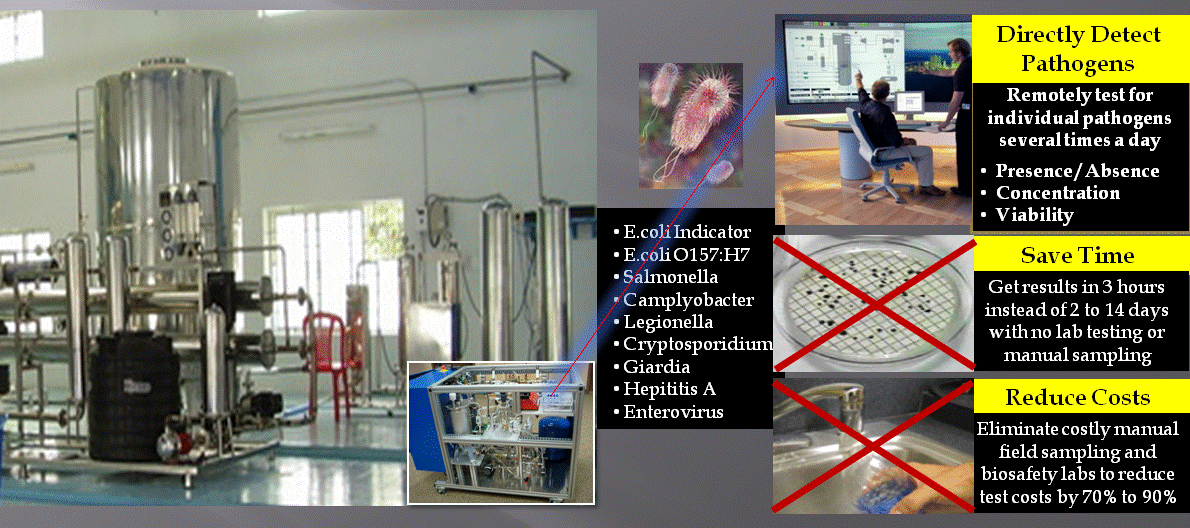
No Technician, No BioSafety Lab, No Tags, No PCR, No Optical Equipment
|
Pathogen Sensor (Limited Release Beta Version)
Early Warning Inc is a spin-off from NASA’s Ames Research Center. Early Warning has developed a Pathogen Sensor that automatically detects pathogenic bacteria, viruses and parasites without a biosafety laboratory or technician, and distinguishes infectious pathogens from harmless microorganisms. The sensor will enable end users to test water, food and people without a laboratory, shorten the test cycle to 3 hours from 2 to 14 days, and reduce the cost per test by 70% to 90%. The Pathogen Sensor employs a multiplexing DNA electrochemical biosensor and a pathogen concentrating device that automatically samples, concentrates and electronically transmits test results. The Pathogen Sensor can be used for Industrial, Municipal Water, Point-of-Use, and Security applications.
Automated Sampling and Detection in 3 Hours
Early Warning’s pathogen sensor automatically measures the presence and concentration of a suite of pathogenic bacteria, viruses and parasites in the same test. This allows water, food and liquefied solids to be sampled and tested any time without a Biosafety laboratory or technician. The pathogen sensor shortens the test cycle from 2 -14 days down to 3 hours, and reduces the cost per test by 70% to 90%. Test results are sent electronically through wireless or wired communications to designated people, devices or websites. The system sanitizes itself after use and is ready for a new sample within 2 hours. The pathogen sensor achieves unprecedented performance for:
Ø Sensitivity - The pathogen sensor generates positive signals from 1 cell per 100 ml sample without PCR or amplification. This is achieved by detecting RNA instead of cells (as there are 20,000 RNA per cell), and processing 10 Liters of sample instead of 100 mLs (to provide 100 times more cells per sample). As a result, over 1 million targets are delivered to the biosensor from a 1 cell per 100 ml sample equivalent. Lower concentrations are possible with bigger sample sizes beyond 10 L which can be automatically sampled and concentrated in the field.
Ø Specificity – Using highly specific DNA probes that only bind with RNA from the target pathogens. Interfering materials are flushed away before detection by extracting target pathogens with antibodies attached to magnetic beads. A preparation recipe can be fine-tuned to the specific input conditions.
Ø Multiplexing – Where the sensor is pre-fabricated with a standard suite of DNA probes (e.g. such as Indicator E.coli, E.coli O157:H7, Salmonella, etc.) attached to individual electrodes so that one electrode can measure E.coli O157:H7 and a second electrode can measure Salmonella. Standard tests are prepackaged and custom probes can be added.
The pathogen sensor employs a pathogen concentrating device and single-use biosensor chips, which are packaged in a replaceable cartridge. The pathogen sensor work as follows:
|
Pathogen Concentrating Device
which automatically samples water or liquids, and prepares RNA of target pathogens for detection on the biosensor chip.
|
Auto Sampling: The concentrator connects to a pipe and collects a 10 Liter liquid sample. 10 Liters are used to increase the likelihood of capturing pathogens which could be missed in a smaller 100 mL grab sample.
Ultrafiltration: The sample is re-circulated through an ultrafiltration filter to remove clean water and retain microorganisms in a highly concentrated retentate.
Magnetic Bead Separation: The retentate is exposed to magnetic beads covered with antibodies of the target pathogens to be detected. A magnetic circuit separates illness-causing pathogens from harmless microorganisms.
RNA Extraction: Pathogens attached to the magnetic beads are further processed by microfluidics to extract RNA from target pathogens using cell lysis and bead filtration.
|
|
Biosensor Chip
A multiplexing DNA electrochemical biosensor that generates electrical signals in proportion to the concentration of individual target pathogens. Single use biochips are packaged in a replacement cartridge.
|
Hybridization: RNA strands are delivered to highly specific DNA probes attached to individually designated electrodes. Each electrode is pre-fabricated with DNA probes from a specific pathogen, such as E.coli O157:H7. Detection can be made when RNA from the sample hybridize with complementary DNA probes.
Electrochemical Detection: Voltammetry scans are applied on each electrode and only the electrodes where hybridization takes place cause guanine to oxidize and subsequently generate electrical current. The peak of the current is measured against background noise to determine if the electrode’s pathogen is present, and against currents from known samples to determine the concentration of the electrode’s pathogen. This is done simultaneously for each electrode to measure the presence and concentration of multiple pathogens in the sample.
Transmit Test Results: Test results are electronically transmitted through wired or wireless communications to designated people, devices or websites. Once done, the system sanitizes itself with the collected filtered water and disinfectant before the next test.
|
Applications for Early Adopters
The pathogen sensor is designed for diverse Industrial, Municipal Water, Point-of-Use, and Security applications.
|
|
|
|
Industrial
|
Food and Beverage Manufacturing
Ø Beverage Companies
Ø Meat, Poultry, Fish Plants
Ø Dairy
Ø Grain products
Ø Fruit & Vegetables
Ø Agriculture
Ø Aquaculture
Bacteria-sensitive Industrial Manufacturing
Ø Medical and Pharmaceutical
Ø Waste Management
Ø Chemical & Biofuels
|
Ø Biosecurity and safe feed water for livestock, slaughterhouses, dairy products, and food and beverage plants
Ø Irrigation and crop processing employing contaminated source or recycled water
Ø Continuous water monitoring for aquaculture, fisheries and marine preservation
Ø Discharge from food processing facilities
Ø Automated sampling throughout the food production and distribution system
Ø Control loop for sanitation equipment effectiveness such as monitoring UV dose and energy use based on pathogen type before UV and pathogen viability after UV
Ø Discharge from processing facilities
Ø Bacteria in cooling towers
|
|
Point of Use
|
Hospitality
Ø Food Services & Restaurants
Ø Entertainment Venues
Ø Beaches and Campgrounds
Ø Transportation vehicles, Airlines, Cruise Ships
Ø Hotels and High end resorts
Ø VIPS, Celebrities & Diplomats
Residential & Commercial Buildings
Ø Airports
Ø Universities
Ø Government Buildings
Ø Living Complexes
Ø Corporate Campuses
Health Care
Ø Medical Facilities
|
Ø Testing water and food prior to consumer contact
Ø Beach operators posting water quality updates onsite and online within hours of sampling
Ø Hospitals and elderly care monitoring drinking and shower water to immuno-compromised, sick and elderly
Ø Transportation vessels, cruise ships, and airlines collecting under-treated drinking water at foreign destinations
Ø Institutional water consumers with large populations such as hotels, universities, multinationals, and government agencies
Ø Special protection for VIPs, celebrities, entertainers, diplomats and luxury resorts
|
|
Water
|
Treatment Plants
Ø Drinking Water
Ø Wastewater
Water Distribution
Ø Municipal Networks
Source Water
Ø Municipalities and wells
Ø Irrigation
Recreational Water
|
Ø Rapid and remote field testing after a turbidity spike or suspicious event
Ø Contaminated source water downstream from farms, sewage treatment plant outfalls, stormwater and combined sewage overflow discharges, biotech industries, or wildlife
Ø Recycled water used for drinking
Ø Network infiltration from aging pipelines or sudden pressure drops
Ø Water security
|
|
Security
|
Government Agencies
Ø Bioterrorism
Ø Healthcare Infection Control
Ø Food Inspection
Contractors
Ø CBRN
Ø Water Infrastructure
|
Ø Inline biosensor in CBRN systems
Ø Remote monitoring of water utilities in violation of regulations
Ø Rapid inspection of imported fruits and vegetables at border crossings before entry into the country
Ø Disaster relief
Ø Military theaters and remote bases
|
|
Last Updated: 31 Mar 2011 ***** As many as 19 million Americans may become ill each year due to parasites, viruses and bacteria in drinking water
***** America Needs a New Strategy for Safe Drinking Water
***** Boil water advisory affects 2 million residents for several days in Boston
***** Cholera outbreak kills 4,037 and infects over 91,000 people from water in Zimbabwe
***** 40 dead, 2,000 infected as first cholera outbreak in 50 years spreads across Papua New Guinea
Thousands of animals in Bulgaria to be killed in latest FMD outbreak
550 million eggs destroyed and 1,500 people sickened by salmonella throughout the US
CDC: Fresh salsa, guacamole linked to 25 outbreaks of foodborne illnesses
5% of Key West, FL population has recently been exposed to the virus that causes dengue fever
Rain forest atrium in senior citizens facility linked to 2 deaths from Legionnaires' disease in Vernon Hills, Il
City officials violate regulated levels of cancer-causing THM to disinfect drinking water from bacteria-infested biofilms in West Glouster, MA
Legionnaire's disease outbreak in water system at at the senior facility on the former site of Memorial Stadium in Baltimore, MD
Leptospirosis bacteria outbreak spread by water contaminated with the urine of rats, dogs and other animals after two tropical storms in the Philippines
***** H1N1 Swine flu pandemic kills over 5,000 and infects 414,000 in 122 countries
Typhoid outbreak from water in Taveuni, Fuji
Citizens Fear They Were Exposed to Contaminated Drinking Water for Months in Sugar Grove, Virginia
Crops, ponds destroyed in quest for food safety following E.coli O157:H7 outbreak in Salinas Valley, California
Diluted cleaning solution responsible for 1 death and died and 14 infected from C. difficile at Saanich Peninsula Hospital in British Columbia
E. Coli O157:H7 in Nestlé Toll House Refrigerated Cookie Dough infects 69 and hospitalizes 34 in US
10 die of hand foot and mouth disease in China
Woman dies of flesh eating infection in Pearl, Hawaii
Ticks carrying Lyme disease found in Niagara, Ontario
Possible E. coli contamination prompts the recall of 4,000 pounds of ground beef in New York
Students infected by salmonella from pudding in Madison, Wisconsin
Bacteria found in school’s water system in Parker, Indiana
Spring water source closed because of high Coliform bacteria levels in New York
10 private water schemes contaminated with E. coli in Leitrim, Ireland
High levels of fecal bacteria found around beach in North Carolina
E. coli found in city creek in Greenwood, Indiana
Drug resistant E. coli found in Hamilton harbor in Ontario
Vancomycin resistant enterococci (VRE) found in a hospital in Perth, Australia
Listeria bacteria found in school canteens, hospitals and retirement homes in Portugal
White nose syndrome found in a park in New Jersey
19 dogs infected with distemper virus, 17 of them euthanized in Brevard, Florida
Alfalfa sprouts recalled due to salmonella contamination in US
Woman dies of bird flu in Vietnam
Medical resident possibly exposed hundreds of babies and co-workers to TB in Chicago
31 children die of hand, foot and mouth disease in China
Distemper outbreak partially shuts down animal shelter in Colorado
Mosquitoes carrying West Nile virus found in Martinez, California
Over a dozen dogs euthanized because of distemper disease in Brevard, Florida


|